
Home
Solutions
Products
Services
About
Careers
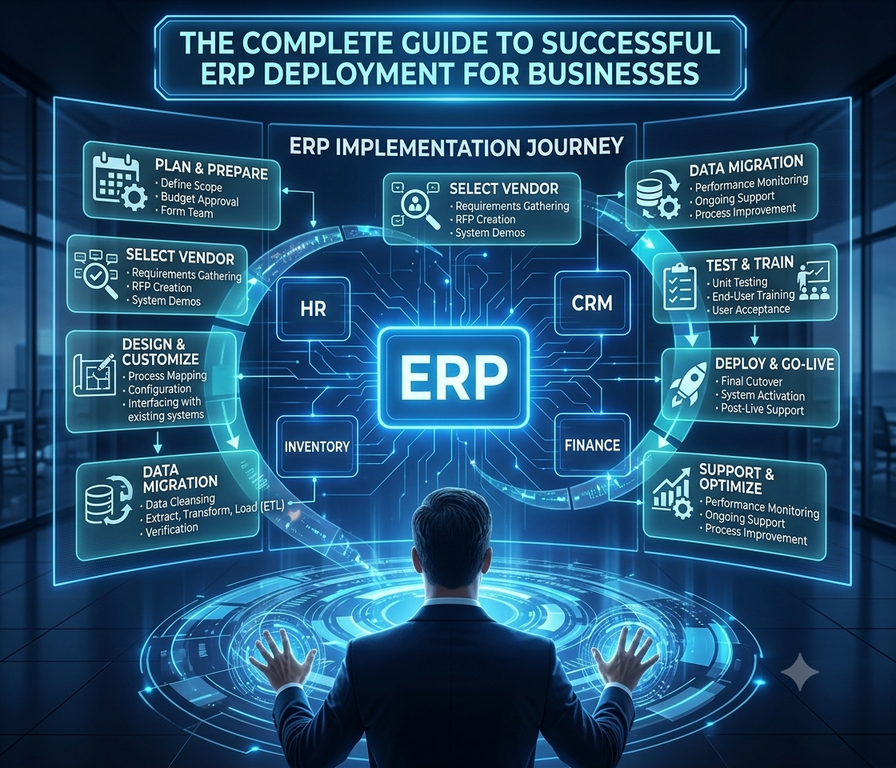

Implementing an ERP system is more than installing new software.
Implementing an ERP system is more than installing new software. It is a business transformation process that changes how departments manage information, perform daily activities, and work together.
A well-planned ERP implementation process helps businesses replace disconnected systems, spreadsheets, and manual processes with a centralized platform. This gives employees access to reliable information and helps management make faster and better-informed decisions.
For businesses considering ERPNext or any other ERP platform, the implementation approach is critical. A successful implementation creates a system that becomes part of everyday operations, while a poorly planned implementation can result in low user adoption, unnecessary complexity, and delays.
What Is ERP Implementation?
ERP implementation is the structured process of introducing an Enterprise Resource Planning system into an organization.
It generally involves:
- Understanding existing business processes
- Identifying operational challenges
- Defining ERP requirements
- Configuring the system
- Migrating existing data
- Testing workflows and transactions
- Training employees
- Going live with the new system
- Providing post-go-live support
The purpose of an ERP system is to connect major business functions such as Sales, Purchasing, Inventory, Manufacturing, Finance, Human Resources, Projects, and Operations within a single platform.
How Does ERP Connect Different Business Functions?
In a properly implemented ERP system, information moves between departments without requiring repeated manual data entry.
For example, when a customer places an order, the ERP system can help the business:
- Check product availability
- Identify additional material requirements
- Initiate purchasing or production activities
- Arrange delivery
- Generate invoices
- Record the financial impact of the transaction
Management can then view updated operational and financial information from the same system.
This integrated approach reduces the dependency on separate spreadsheets and standalone applications.
Why Is a Well-Planned ERP Implementation Important?
As businesses grow, managing operations through disconnected software systems becomes increasingly difficult.
Different departments may maintain their own records, resulting in duplicate information and inconsistent data. Employees may spend significant time entering the same information in multiple systems, while management may need to wait for reports to be manually prepared.
These challenges can lead to:
- Duplicate or inaccurate data
- Limited visibility across departments
- Delays in business processes
- Increased manual work
- Difficulty generating reliable reports
- Poor coordination between teams
- Slower decision-making
A well-planned ERP implementation brings these processes together within one system.
Key Benefits of ERP Implementation
Centralized Operations:
Different business functions can be managed from a common system.
Greater Automation:
Routine and repetitive activities can be automated, reducing manual effort.
Improved Efficiency:
Standardized workflows help employees complete tasks more effectively.
Real-Time Information:
Management can access current operational and financial information for better decision-making.
Better Collaboration:
Departments can work with shared information instead of maintaining separate records.
Improved Data Accuracy:
A common database reduces duplicate entries and inconsistencies between departments.
Business Scalability:
ERP systems can support additional users, locations, products, and business processes as the organization grows.
What Are the Main ERP Implementation Steps?
Although every organization has different requirements, a successful ERP implementation process generally follows the following stages.
Step 1 – Business Requirement Analysis
The first step is understanding how the organization currently operates.
The implementation team works with key users and management to identify:
- Existing business processes
- Operational challenges
- Reporting requirements
- Approval workflows
- Department responsibilities
- Current software systems
- Business objectives
The goal is to clearly understand what the organization expects the ERP system to improve.
A good requirement analysis provides the foundation for the entire ERP implementation.
Step 2 – ERP Planning and Solution Design
Once the requirements are understood, the implementation team prepares the ERP solution design.
This stage normally defines:
- Modules to be implemented
- Project scope
- Business workflows
- User roles and permissions
- Required integrations
- Customization requirements
- Data migration requirements
- Implementation timeline
- Project responsibilities
Where possible, businesses should use standard ERP functionality instead of introducing unnecessary customizations.
Custom development should generally be considered when there is a genuine business requirement that cannot be handled effectively through standard system features.
Step 3 – System Configuration and Data Migration
The ERP system is then configured according to the approved business processes.
This may include creating:
- Companies and business units
- Chart of Accounts
- Customers and suppliers
- Products and services
- Warehouses
- Taxes
- Price lists
- Users and permissions
- Workflows and approval rules
Existing business data must also be reviewed before migration.
Poor-quality master data can create significant problems after go-live. Businesses should therefore clean, validate, and remove duplicate information before uploading it into the new ERP system.
Step 4 – Testing, Training and Go-Live
Before the system goes live, users should test the configured processes using realistic business scenarios.
Testing should confirm that important transactions, workflows, permissions, reports, and integrations operate correctly.
Employees should then receive training based on their responsibilities. For example, a sales employee may require training on quotations, sales orders, and customer management, while an accounts employee may need training on invoices, payments, reconciliation, and financial reports.
Once testing is completed and the required data is migrated, the organization can begin live operations.
Post-go-live monitoring and support are also important during the initial period to resolve issues and help employees become comfortable with the new system.
| Implementation Stage | Main Objective | Expected Outcome |
| Requirement Analysis | Understand business requirements | Clearly defined ERP requirements |
| Planning & Solution Design | Define how ERP will support operations | Implementation roadmap |
| Configuration & Data Migration | Configure the system and migrate information | Working ERP environment |
| Testing, Training & Go-Live | Validate the system and prepare users | ERP ready for business operations |
What Are the Common ERP Implementation Challenges?
1. Poor Planning and Unclear Objectives
Without clearly defined objectives, ERP projects can gradually expand beyond their original scope.
This may lead to unnecessary customization, changing requirements, additional costs, and delays.
Businesses should establish clear project objectives and priorities before implementation begins.
2. Complex Data Migration
Many organizations have years of customer, supplier, product, inventory, and financial information stored across different systems.
Migrating all this information without reviewing it can transfer existing errors into the new ERP system.
Data should therefore be cleaned, organized, validated, and approved before migration.
3. Employee Resistance and Low User Adoption
An ERP system can deliver results only when employees use it correctly.
Employees should be involved during the implementation process so they understand why the organization is introducing the new system and how it will improve their daily activities.
Role-specific training is equally important for successful adoption.
4. Excessive Customization
Trying to modify the ERP system to reproduce every process from the previous software can increase project complexity.
Organizations should first evaluate whether existing processes can be simplified or managed using standard ERP functionality.
5. Cost Overruns and Implementation Delays
ERP projects may exceed their planned budget or timeline when requirements continuously change or responsibilities are unclear.
A defined scope, realistic project plan, clear ownership, and regular progress reviews help keep implementation under control.
How Do You Choose the Right ERP Implementation Partner?
Selecting the right ERP implementation partner can significantly influence the success of the project.
Industry and ERP Experience
The implementation partner should understand both the ERP platform and the business environment in which it will be used.
Manufacturing, distribution, retail, services, healthcare, and project-based organizations have different operational requirements.
Implementation Capabilities
A capable ERP partner should be able to assist with:
- Requirement analysis
- Solution design
- ERP configuration
- Data migration
- Customization
- Integration
- User training
- Testing
- Go-live support
- Ongoing functional and technical support
An experienced implementation partner can also identify potential risks early and recommend practical solutions before they become larger problems.
ERP Implementation Best Practices
Businesses can improve the chances of a successful ERP implementation by following a few important practices:
- Define clear project objectives.
- Keep the implementation scope realistic.
- Involve key users from the beginning.
- Assign responsibilities to both internal and implementation teams.
- Clean and validate master data before migration.
- Avoid unnecessary customization.
- Test complete business scenarios before go-live.
- Provide role-specific user training.
- Maintain regular project reviews.
- Provide adequate support after go-live.
Frequently Asked Questions
What is the ERP implementation process?
The ERP implementation process is the structured approach used to introduce an ERP system into an organization. It normally includes requirement analysis, planning, configuration, data migration, testing, user training, go-live, and post-implementation support.
How long does ERP implementation take?
The duration depends on factors such as company size, number of users, modules, locations, business complexity, data volume, integrations, and customization requirements.
Clearly defining the project scope before implementation can help create a more realistic timeline.
What are the main ERP implementation challenges?
Common challenges include unclear requirements, poor planning, inaccurate data, employee resistance, excessive customization, scope changes, cost overruns, and implementation delays.
Why is data migration important?
ERP systems depend on accurate information. Migrating incorrect, duplicate, or outdated data can affect transactions and reports after go-live.
Existing data should therefore be reviewed, cleaned, and validated before migration.
Why is employee training important?
Employees need to understand how the ERP system relates to their daily responsibilities.
Proper training improves user adoption, reduces mistakes, and helps organizations receive greater value from their ERP investment.
How much does ERP implementation cost?
ERP implementation costs vary depending on the ERP platform, number of modules, users, locations, business processes, customization, integrations, data migration, training, and support requirements.
Conducting a detailed requirement analysis helps businesses estimate the implementation budget more accurately.
How Can You Build a Successful ERP Implementation?
Successful ERP implementation begins with understanding the business rather than simply configuring software.
Clear requirements, realistic planning, clean data, appropriate system configuration, thorough testing, employee training, and strong post-go-live support all contribute to a successful deployment.
Choosing the right implementation partner is equally important. ERP becomes a core part of how an organization manages its operations, and the implementation approach should therefore support both current requirements and future growth.
Looking for ERP implementation services?
Businesses across different industries and regions can rely on Wahni IT Solutions for ERPNext implementation, customization, data migration, user training, integrations, and ongoing support.