
Home
Solutions
Products
Services
About
Careers
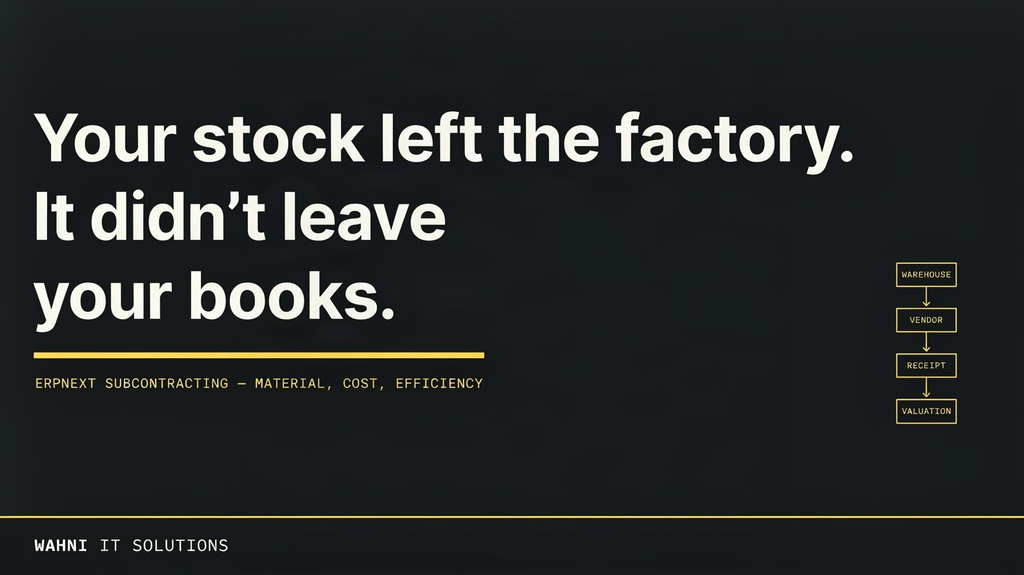

Manage inward and outward subcontracting with ERPNext. Track material movement, consumption, wastage, processing costs and subcontractor performance in one connected system.
Manufacturing doesn't always happen within your own factory. Components may be sent outside for machining, heat treatment, powder coating or assembly. In other cases, your factory may receive raw materials from customers, process them and return the finished products.
In both situations, one question matters: How do you maintain control over materials, production, costs and delivery when another company is involved?
Imagine sending 1,000 kg of raw material to a subcontractor. How much has been consumed? How much finished material has been received? What quantity is still lying with the subcontractor? Has there been excess wastage? Is the processing cost within the agreed rate?
For many manufacturers, these answers are scattered across Excel sheets, delivery challans, production registers and supplier statements.
ERPNext helps connect these activities through its manufacturing, inventory, purchasing and accounting workflows. With the introduction of structured inward subcontracting in ERPNext Version 16, businesses can manage both sides of the subcontracting process more effectively.
Understanding Inward and Outward Subcontracting
Subcontracting generally works in two directions.
Outward Subcontracting: Sending Materials for Processing
Consider an engineering company manufacturing precision components. It performs machining internally but sends the components to an external vendor for heat treatment.
The company supplies the material, the vendor performs the operation, and the processed components are returned.
Throughout this process, the manufacturer needs to track:
- Materials issued to the subcontractor.
- Quantities consumed during processing.
- Finished components received.
- Materials still pending with the vendor.
- Scrap, rejection and process loss.
- Processing charges and additional costs.
Although the material is physically outside the factory, it remains under the manufacturer's inventory control.
ERPNext supports this process through subcontracting purchase orders, subcontracting orders, material transfers and subcontracting receipts.
Inward Subcontracting: Processing Customer-Owned Materials
Now consider a fabrication company that receives 2,000 kg of steel from a customer.
The company uses this material to manufacture components, delivers the finished products and charges the customer for fabrication services.
Here, the raw material belongs to the customer. However, the manufacturer is responsible for recording its receipt, consumption, wastage and return.
ERPNext Version 16 provides a structured inward subcontracting workflow that connects customer orders, material receipt, production, finished-goods delivery and service billing.
This is particularly relevant for precision engineering companies, fabrication units, job-work manufacturers and businesses undertaking contract manufacturing.
The Biggest Challenge: Knowing Where Your Materials Are
One of the most common problems in subcontract manufacturing is losing visibility once materials leave the warehouse.
A company may have issued materials to several subcontractors, each working on different orders. Some materials may have been consumed, some may have been returned as finished goods, and others may still be awaiting processing.
Without proper tracking, even a simple stock reconciliation can become difficult.
ERPNext allows businesses to maintain subcontractor-specific warehouses and record material movements against the relevant transactions.
For outward subcontracting, materials transferred to a subcontractor's warehouse remain visible in the company's inventory records. When finished goods are received, the corresponding material consumption can be recorded.
This helps businesses answer an important operational question:
How much of our material is currently lying with each subcontractor, and against which order?
For inward subcontracting, ERPNext v16 supports customer-specific warehouse arrangements and stock reservation, helping businesses maintain separation between customer-provided materials and their own inventory.
Proper warehouse configuration and transaction discipline are essential to obtaining accurate balances.
How Outward Subcontracting Works in ERPNext
Consider a manufacturing company outsourcing powder coating.
1. Define the manufacturing requirement
A Bill of Materials (BOM) identifies the raw materials required for the processed product. The subcontracting service item represents the processing service being purchased.
2. Create the subcontracting purchase order
The company creates a Purchase Order for the subcontracting service, identifying the processed product and required quantity.
3. Transfer materials to the subcontractor
A Subcontracting Order is created, and the required raw materials are transferred to the subcontractor's warehouse using the appropriate stock transaction.
The system records the material movement and helps maintain visibility of stock at the vendor's location.
4. Receive the processed goods
When the subcontractor completes the work, a Subcontracting Receipt records the finished goods and associated raw material consumption.
Partial receipts can be recorded when the vendor completes processing in batches.
5. Account for processing costs
The finished-product valuation can include raw material costs and subcontracting charges.
ERPNext v16 also supports Landed Cost Vouchers against Subcontracting Receipts, helping businesses allocate applicable additional expenses such as freight and handling.
This creates a connected record of material movement, processing and costing.
Inward Subcontracting in ERPNext Version 16
Inward subcontracting is one of the important manufacturing enhancements highlighted in ERPNext v16.
Earlier versions could accommodate customer-provided material workflows, but businesses often needed additional manual transactions and reconciliation.
Version 16 introduces a more structured process.
Consider a manufacturer receiving customer-owned steel for fabrication.
1. Receive the customer order
A subcontracted Sales Order captures the processing requirement and the related finished goods.
2. Receive customer-owned materials
A Subcontracting Inward Order helps manage the receipt of materials supplied by the customer.
Customer-specific warehouses and the relevant item settings help maintain material ownership and stock separation.
3. Plan and execute production
Work Orders are used to manufacture the required components, with material consumption recorded through the production workflow.
The process can also accommodate materials supplied by the manufacturer, subject to the supported configuration.
4. Deliver finished products
The completed goods are delivered to the customer through the inward subcontracting delivery workflow.
Unused customer materials can be returned through the supported process.
5. Invoice the processing service
The manufacturer raises an invoice for the agreed processing charges and any applicable materials or additional services supplied by the manufacturer.
The objective is to track customer-owned materials operationally without treating them as ordinary purchased inventory.
Businesses planning to adopt this workflow should verify its suitability for their production methods, especially where complex batch processing, alternative materials or specialised manufacturing transactions are involved.
Measuring Subcontractor Efficiency
Tracking inventory is only the beginning.
A manufacturer also needs to understand whether each subcontractor is performing efficiently.
Two vendors may quote the same processing rate but deliver very different results in material consumption, quality, turnaround time and overall cost.
ERPNext captures transaction information that can be used to evaluate these differences.
1. Material Yield and Wastage
Suppose a company issues 1,000 kg of material for processing.
The subcontractor returns 940 kg of acceptable finished material.
Where input and output quantities are directly comparable:
Material Yield = (Accepted Output ÷ Material Input) × 100
Material Yield = (940 ÷ 1,000) × 100 = 94%
However, the remaining 60 kg should not automatically be considered wastage.
It may include scrap, rejected material, normal process loss or material still awaiting processing.
A meaningful yield calculation requires these quantities to be reconciled and compared with the expected process standards.
2. Subcontractor Turnaround Time
How long does a subcontractor take to complete an order?
ERPNext transaction dates can support comparisons between planned and actual processing time.
For example, if the agreed turnaround is seven days but the vendor consistently takes ten days, the delay may affect the manufacturer's own production and delivery commitments.
Tracking turnaround by subcontractor helps purchasing and production teams make better decisions.
3. Quality and Rejection Rates
Processing quality is equally important.
A subcontractor offering a lower rate may generate more rejected components, rework and production delays.
Quality Inspection records, together with the relevant order and receipt information, can support analysis of accepted quantities, rejected quantities and vendor-wise quality performance.
4. Actual Processing Cost
The agreed processing rate is not always the final cost.
Freight, handling, rework, excess consumption and other expenses can affect the actual cost of subcontracted goods.
By capturing applicable expenses and inventory valuation correctly, businesses can compare expected and actual subcontracting costs.
5. Pending Materials and Orders
Manufacturers should also know which orders are still pending and how much material remains with each subcontractor.
A consolidated view can help identify overdue processing, pending receipts and stock requiring reconciliation.
What Could a Subcontractor Performance Dashboard Show?
A well-designed subcontracting dashboard could bring important operational indicators together.
Consider the following illustrative example.
| Performance indicatorValue | |
| Material issued | 1,000 kg |
| Accepted finished output | 940 kg |
| Material yield | 94% |
| Material pending with vendor | 22 kg |
| Recorded scrap and rejection | 38 kg |
| Average turnaround | 9.4 days |
| Agreed turnaround | 7 days |
| Processing cost variance | +7.8% |
The quantities reconcile to 1,000 kg, assuming comparable units and no other recorded losses.
The dashboard immediately highlights three concerns: material remains with the vendor, delivery is slower than agreed, and processing costs exceed expectations.
Instead of checking multiple reports and following up manually, management can review the exceptions and take action.
An important distinction: ERPNext provides much of the underlying transaction data, but a consolidated dashboard combining yield, turnaround, rejection, pending material and cost variance may require configured reports, Frappe Insights or custom development.
The exact reporting requirements should be identified during implementation.
Comparing Subcontractors Beyond Processing Rates
Selecting a subcontractor purely on quoted rates can be misleading.
Consider two vendors offering the same processing charge.
| IndicatorVendor AVendor B | ||
| Processing rate | ₹18/kg | ₹18/kg |
| Material yield | 94% | 91.5% |
| Average turnaround | 9.4 days | 6.8 days |
| Rejection rate | 1.6% | 3.4% |
| Cost variance | +7.8% | +2.1% |
Illustrative figures.
Vendor A has better yield and fewer rejections, while Vendor B completes processing faster and has lower cost variance.
Neither is automatically the better choice.
The right subcontractor depends on the manufacturing operation, delivery commitment, material value and quality requirements.
This is why subcontractor performance should be measured through a combination of cost, quality, material efficiency and delivery reliability, rather than processing rates alone.
What's New for Subcontracting in ERPNext v16?
ERPNext Version 16 introduces several capabilities relevant to subcontract manufacturing.
Structured Inward Subcontracting
A connected workflow for receiving customer-owned materials, manufacturing finished goods, managing delivery and billing processing services.
Improved Material Reservation
Stock reservation capabilities help protect materials allocated to specific manufacturing requirements. The inward subcontracting workflow also uses reservation to maintain control over customer-provided stock.
More Flexible Subcontracting Execution
Improvements to subcontracting orders support more flexible handling of processing requirements and multiple execution stages.
Better Cost Allocation
Landed Cost Vouchers can now be applied to Subcontracting Receipts, allowing eligible additional costs to be included in inventory valuation.
Enhanced Serial and Batch Traceability
ERPNext v16 introduces improved serial and batch traceability reporting, helping manufacturers investigate the movement and usage of tracked materials.
These capabilities strengthen the connection between subcontracting, manufacturing, inventory and costing.
Industries Where Subcontracting Management Matters
Subcontracting is common across many manufacturing sectors, although the operational requirements vary.
Precision Engineering
Components may move through machining, grinding, heat treatment and surface finishing. Accurate material tracking, quality inspection and turnaround monitoring are essential.
Metal Fabrication
Materials may be sent for cutting, bending, welding, powder coating or assembly. Each movement needs to be recorded to maintain stock accountability.
Garment Manufacturing
Fabric may be issued for stitching, embroidery, washing or finishing. Businesses need to monitor fabric consumption, finished quantities, rejected items and pending production.
Food and Chemical Processing
Contract manufacturers may receive ingredients or intermediate products for processing. Batch traceability, material yield, quality control and production records can be important requirements.
The manufacturing processes differ, but the need for inventory visibility, material accountability and reliable costing remains the same.
Why Implementation Design Matters
ERPNext provides the framework for managing subcontracting, but the effectiveness of the solution depends on how the business process is designed.
Before implementation, manufacturers should clearly define material ownership, warehouse structure, BOMs, expected process losses, quality checkpoints, valuation methods and billing arrangements.
For example, a company outsourcing a single powder-coating operation may need a relatively straightforward workflow.
A manufacturer sending materials through three different subcontractors, with intermediate processing, multiple quality checks and partial receipts, may require more detailed workflow design and reporting.
Similarly, businesses wanting subcontractor scorecards, vendor-wise yield analysis or advanced exception dashboards may need additional configuration or custom development.
The objective should not be to introduce unnecessary complexity. It should be to make material movements easier to track and give management reliable information for decision-making.
Bringing Subcontracting Under Better Control with Wahni
At Wahni IT Solutions, we work with manufacturing businesses to implement ERPNext around their actual production, inventory and operational requirements.
Our experience across engineering, precision manufacturing, fabrication and other manufacturing industries helps us understand the practical challenges of material movement, subcontracting, quality control and production costing.
Whether your business sends materials to subcontractors or processes customer-owned materials, a properly designed ERPNext implementation can improve visibility and accountability throughout the process.
Want to know how much material is pending with your subcontractors, what each job actually costs, and which vendors are performing efficiently?
Talk to Wahni IT Solutions about implementing ERPNext for your subcontract manufacturing operations.
Website: www.wahni.io
Frequently Asked Questions
Can ERPNext track materials sent to subcontractors?
Yes. ERPNext supports material transfers to subcontractor warehouses and records material consumption and finished-goods receipts through its outward subcontracting workflow.
Does ERPNext support inward subcontracting?
Yes. ERPNext v16 introduces a structured inward subcontracting workflow for receiving customer-owned materials, managing production, delivering finished goods and invoicing processing services.
Can ERPNext track wastage during subcontracting?
ERPNext can record material consumption and scrap through relevant subcontracting and manufacturing transactions. Detailed yield analysis and wastage comparisons may require additional reporting.
Can ERPNext measure subcontractor efficiency?
Yes. ERPNext transaction data can support analysis of material yield, turnaround time, quality performance, pending quantities and processing costs. Consolidated efficiency dashboards may require configuration or customisation.
Can ERPNext manage multiple subcontractors?
Yes. Different suppliers, subcontractor warehouses, purchase orders and material transactions can be maintained to provide vendor-wise inventory visibility.
Can ERPNext track customer-owned materials?
Yes. ERPNext v16's inward subcontracting workflow supports receiving and processing customer-provided materials, with warehouse and stock controls designed to maintain separation from the manufacturer's own inventory.